
Ethiopia’s Birth in 1945: Ethiopia was never born—it was manufactured
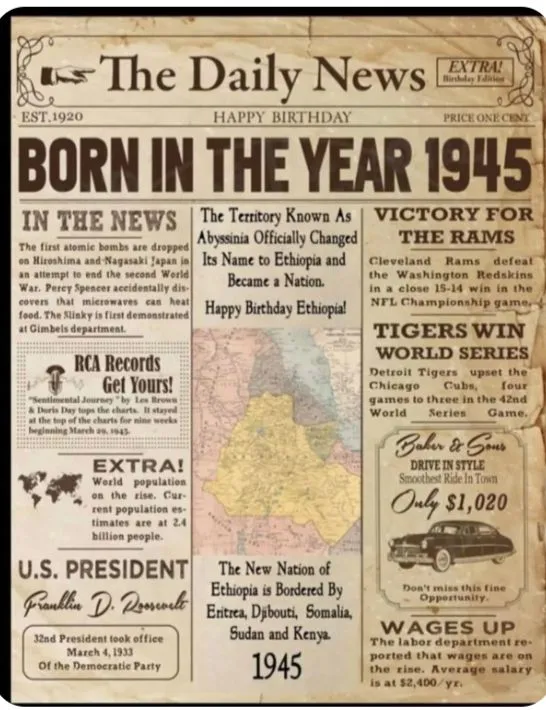
The newspaper clipping is more than nostalgia—it is propaganda wrapped in parchment. It declares that in 1945 “the territory known as Abyssinia officially changed its name to Ethiopia and became a nation.” This statement alone is a political earthquake, because it exposes the great deception that has fueled one of Africa’s longest-standing myths: that Ethiopia is an ancient, continuous, unified nation-state.
The Myth of “Ethiopia” as a Timeless Nation
For decades, Western textbooks and Ethiopian elites have woven the narrative that Ethiopia is the world’s oldest Christian kingdom, a timeless polity that survived colonialism and emerged triumphant in the 20th century. But the truth, as this 1945 map slyly admits, is that “Ethiopia” was invented—a manufactured nation-state project forced upon dozens of conquered peoples.
Until the mid-20th century, the region was more accurately known as Abyssinia, a highland empire dominated by Amhara and Tigrayan elites. It was never a nation, but an empire forged through conquest. In the late 19th and early 20th centuries, under Menelik II and later Haile Selassie, Abyssinia expanded south, east, and west, swallowing entire nations: Oromo, Somali, Sidama, Afar, Gambella, Benishangul, and beyond. Each was incorporated not through consent, but through bayonet and massacre.
The 1945 proclamation of Ethiopia as a “new nation” was therefore not a birth of freedom but the codification of conquest—a state baptized by force and legitimized by post–World War II geopolitics.
The Cold War Blessing of Empire
It is no coincidence that this renaming coincided with the end of the Second World War. The West, eager to crown African “exceptionalism” and find a loyal outpost in the Horn, accepted the fiction of Ethiopia as an ancient nation reborn. The League of Nations had already disgraced itself by failing to stop Mussolini’s invasion in 1935. In the aftermath, Ethiopia was restored under Haile Selassie not as an empire of many nations, but rebranded as a single state—“Ethiopia.”
This suited Western powers. Ethiopia became the UN’s African showcase, a founding member in 1945, even as Somali territories, Eritrea, and Oromo lands languished under enforced assimilation. The Cold War required stable allies, not messy truths. Washington and London needed Ethiopia to be eternal, indivisible, and Christian—so they stamped Abyssinia’s new passport with the name “Ethiopia” and called it ancient.
Erased Nations, Silenced Histories
Look carefully at the map in the newspaper. It describes Ethiopia as “bordered by Eritrea, Djibouti, Somalia, Sudan, and Kenya.” But what about the peoples within? What about the Oromos, whose population today outnumbers the Amhara but whose very name was outlawed for decades? What about the Somali Ogaden, forcibly incorporated in 1887, never consulted, and brutally repressed in every uprising? What about the Sidama, the Afar, the Gambella, the Wolayta—all reduced to provinces inside a “new nation” born without their consent?
This cartography is not neutral; it is violence disguised as ink. It erases the reality that Ethiopia was—and remains—an empire of nations, never a single homogenous state.
The Political Consequence: Endless Rebellion
The lie of 1945 is still haunting Ethiopia today. The state was never born as a consensual federation but as a prison of nations. Every rebellion since—Eritrea’s 30-year war of independence, the Oromo struggle, the Ogaden insurgencies, Tigrayan defiance—flows directly from this foundational falsehood. Ethiopia was not born in 1945; it was imposed in 1945.
That imposition created a brittle façade of unity, cracked by endless wars. The Horn of Africa continues to pay the price for this deceit, as Western powers cling to the myth of Ethiopian exceptionalism while ignoring the voices of oppressed peoples within.
Conclusion: Abyssinia Rebranded, Africa Betrayed
This map and its celebratory headline—“Born in the Year 1945”—should not be read as history, but as a confession. A confession that Abyssinia’s rebranding as Ethiopia was not the organic birth of a nation but a colonial-style reorganization of empire. It is a birthday card for a lie, one that erased nations, legitimized conquest, and planted the seeds of perpetual war.
The lesson is simple: Ethiopia was never born—it was manufactured. Until the peoples within its borders reclaim their histories and renegotiate their coexistence, the empire will remain a time bomb, wrapped in the old myth of a “timeless nation.”
Ismail Haji Warsame | Warsame Digital Media (WDM) | X: @ismail.warsame
COMMENTS